
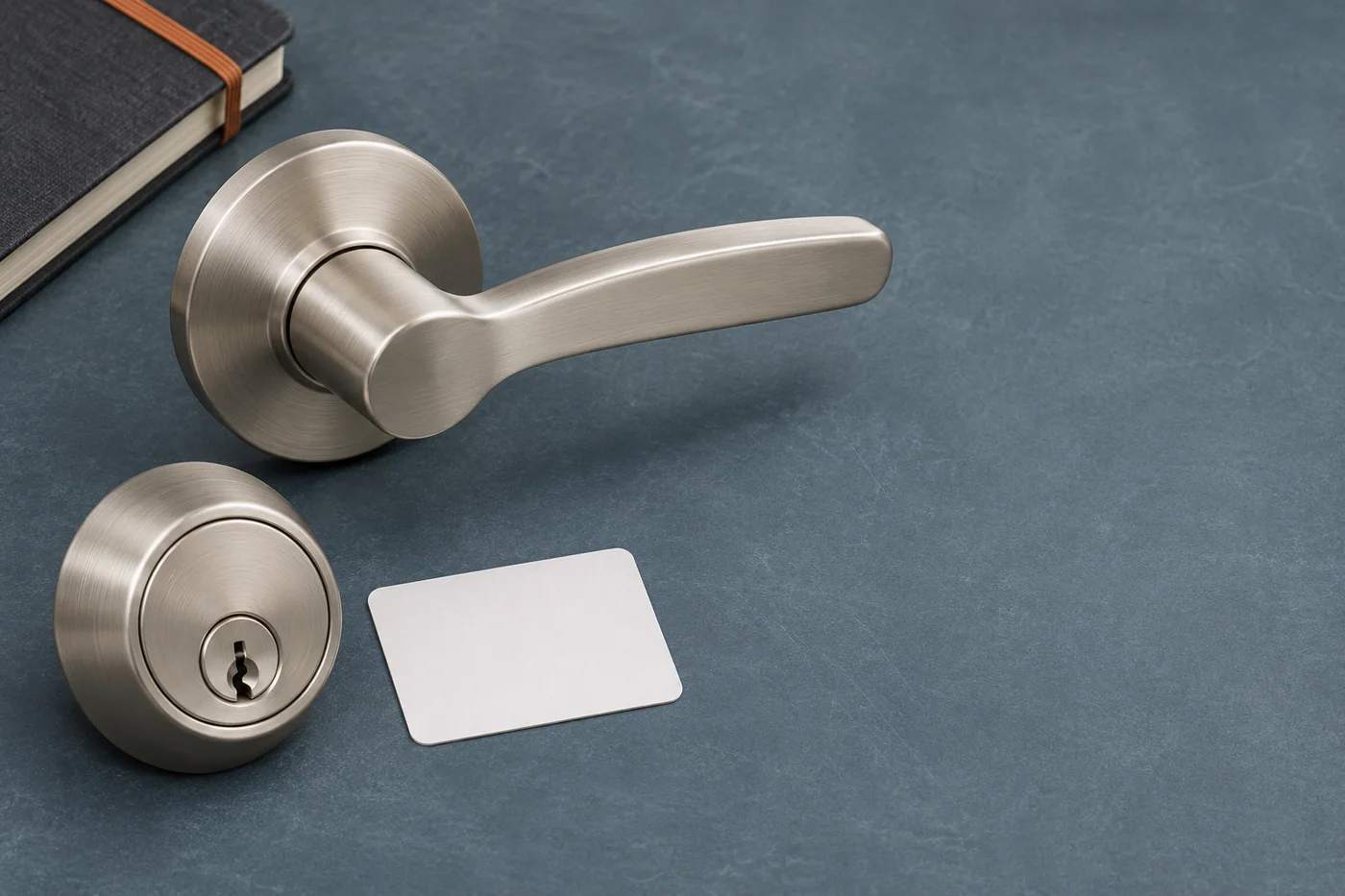
The second handle looks almost identical to the first. That can be reassuring on a shopping page without answering whether it will fit the door or perform the right job. A photograph shows appearance; the product's identity and specification explain more.
Before ordering replacement door hardware, keep a short record of the entrance, the current part and the function you want restored. This is preparation for an assessment, not a set of instructions to dismantle or drill a door.
Start the record with the entrance
Give the door an unambiguous description: front entry, side pedestrian door, staff room or another actual location. That prevents a useful model reference being applied to a similar-looking handle elsewhere in the property.
Add whether the entrance is private or shared and who can authorize changes. A new part can affect access and use, so the person who places the order may need an owner or manager involved before work is agreed.
Keep names that belong to different products
A door maker, a handle maker and a keypad brand can all appear in the paperwork. Keep each one rather than deciding that the most prominent logo identifies the complete entrance. An order confirmation may identify the door without specifying every piece of hardware.
A readable model reference, installation invoice or packaging label can help connect a part to the right manufacturer documentation. If it is already available, keep it with the entrance record. Do not remove a working or damaged mechanism merely to search for a number.
Describe the function as well as the appearance
What did the existing part do during ordinary use? A handle used only for passage is not the same request as a lock that must secure an entrance. A cylinder's physical key and a keypad's code can also provide separate kinds of access.
Write the intended result in everyday terms: normal handle return, reliable latching, operation by the agreed key, or another specific function. If a previous replacement did not restore that function, keep the remaining symptom in the record.
Fit comes from the right specification
Manufacturer fitting information can refer to backset, crossbore and door thickness. Those terms describe different parts of the fit; knowing one does not settle all of them. The appropriate guide belongs to the actual lock family and door.
Schlage's door-and-frame preparation material checks several dimensions. Allegion's backset information also shows why offerings vary by lock family. Neither is a reason to apply one familiar measurement to every product. A qualified installer should verify the relevant fit before a purchase.
Keep the product link or specification sheet if you have a candidate replacement. That is more useful than relying on a photograph saved without its model or size information. This guide deliberately gives no drilling layout or universal fitting dimension.
Photos can support the record without becoming a project
Safely visible overall, handle and frame views can help explain the entrance. Existing photographs taken when the hardware was supplied may be useful too. Keep the door's condition and the symptom in the description, rather than assuming an image diagnoses the fault.
Do not stand in a hazardous position, disturb an insecure entrance or take hardware apart for a better photograph. If the relevant information is not accessible, leave that identification to the assessment.
Buying a part and agreeing the repair are separate steps
A suitable replacement may be one part of the work. The full request still needs the fault, fitting, permission and intended result checked. A new handle does not automatically change physical-key access, remove a code or repair every problem at the frame.
If you already bought a part, keep its packaging and exact details. Explain that it is customer-supplied before assuming it can be used. The part's identity and the job's scope should be clear before an installation is arranged.
Use the record for the right request
For a recurring mechanical problem, start with lock repair. For a home entrance with several access methods, read the residential guide. If the hardware works but the physical-key access should change, rekeying is a different decision.
In Glendora and the selected surrounding places, call 626-498-1755 about the actual entrance and current availability. The Covina page applies the hardware-record idea to a local request without assuming what is fitted at a particular property.
Questions about the request
Is a similar-looking handle a safe match?
Appearance alone is not a fitting or function check. Use the exact product identity and an assessment of the actual door.
Should I measure everything myself?
Keep existing specifications and safely available information. A qualified installer should verify the fit; no disassembly or drilling is needed for this record.
Does the door maker name identify the lock?
Not necessarily. The door, handle, cylinder and connected components can have separate product identities.